September kicks off with a pretty packed calendar of events (at least for us).
On Sept. 19, Guglielmo Mattioli will be in Reggio Calabria to talk about how climate change is reshaping territories and the lives of the people who live in them, as part of the Biennale dello Stretto. On Oct. 3 and 4, you’ll find us at BASE, in Milan, for Mag to Mag, a fair for independent magazines. And finally, on Oct. 22 at 6 p.m., we’ll be in Palermo where, in the courtyard of the Booq community library, we’ll talk about wildfires and climate change, with a particular focus on Sicily, together with our fellow Stefania D’Ignoti, Pierluigi Bizzini from Fada Collective, researchers from the University of Palermo and many others. If you are around, don’t be a stranger.
In the meantime, in this issue of Lapilli we take stock of some of the past month’s major climate events, from heatwaves across Europe and North Africa to record-high ocean temperatures. We also talk about cetaceans and shipping traffic, desert truffles in an increasingly arid Spain and mountains destabilized by thawing permafrost and other processes set in motion by human-induced global warming.
And, as always, there’s much more.

An (un)forgettable summer. In mid-August, a new heatwave swept across Europe — the fifth since May (although we’d challenge most of you to say exactly where one ended and the next began). Spain and France were among the hardest-hit countries, but it was the United Kingdom that saw temperatures that seemed almost unthinkable at those latitudes, topping 38 degrees Celsius (100.4 degrees Fahrenheit). The UK’s national weather service said this summer could become the hottest ever recorded in the country. For the first time, the UK recorded four separate days with temperatures of 36° C (96.8° F) or higher. By Aug. 13, France had also endured 17 consecutive days of extreme heat, one of the longest stretches ever observed. Temperatures reached 39° C (102.2° F) in Bordeaux and 37° C (98.6° F) in Nantes and Paris. In Spain, the town of Miranda de Ebro, near the border with the Basque province of Álava, hit 42.4° C (108.3° F), raising concerns about the country’s already dire wildfire situation.
As Elisabetta Povoledo reported in The New York Times article linked above, more and more tourists are reconsidering the idea of spending their summer vacations in Europe, while locals are beginning to favor air-conditioned afternoons at the movies over scorching beaches. According to a longform article in The New Yorker, these past few months may signal the decline — if not the end — of summer cultural tourism in cities such as Paris, Milan and Barcelona. Despite some of those cities’ adaptation efforts (with climate shelters, more strategic use of greenery and cooling systems that use river water), travelers may increasingly look toward cooler destinations farther north — and locals toward places where they can escape the heat.
In Italy, some of the most unbearable days of the past month came on Aug. 27 and 28, when another heatwave (the fifth to hit the boot-shaped country) swept across central and southern Italy accompanied by high humidity. While in the north a tornado accompanied by hail hit Cremona, causing extensive damage to roofs, cars and monuments, in Sardinia, a town in Ogliastra came close to 46° C (114.8° F). Similar temperatures were recorded in the province of Cosenza, in Calabria.
“This mix of scorching and humid heat,” meteorologist Giulio Betti wrote on Instagram, “is caused by the combined action of an advection (editor’s note: the horizontal transfer of an atmospheric property — such as heat, cold or moisture — from one region to another) of desert subtropical origin with Atlantic air masses.” Between the two, according to Betti, a cloudy area known as the Warm Conveyor Belt — essentially a flow of warm, humid air capable of generating heavy precipitation — became wedged in. Saharan dust and wildfire smoke blowing in from North Africa further blurred the sky and made the air feel even heavier.
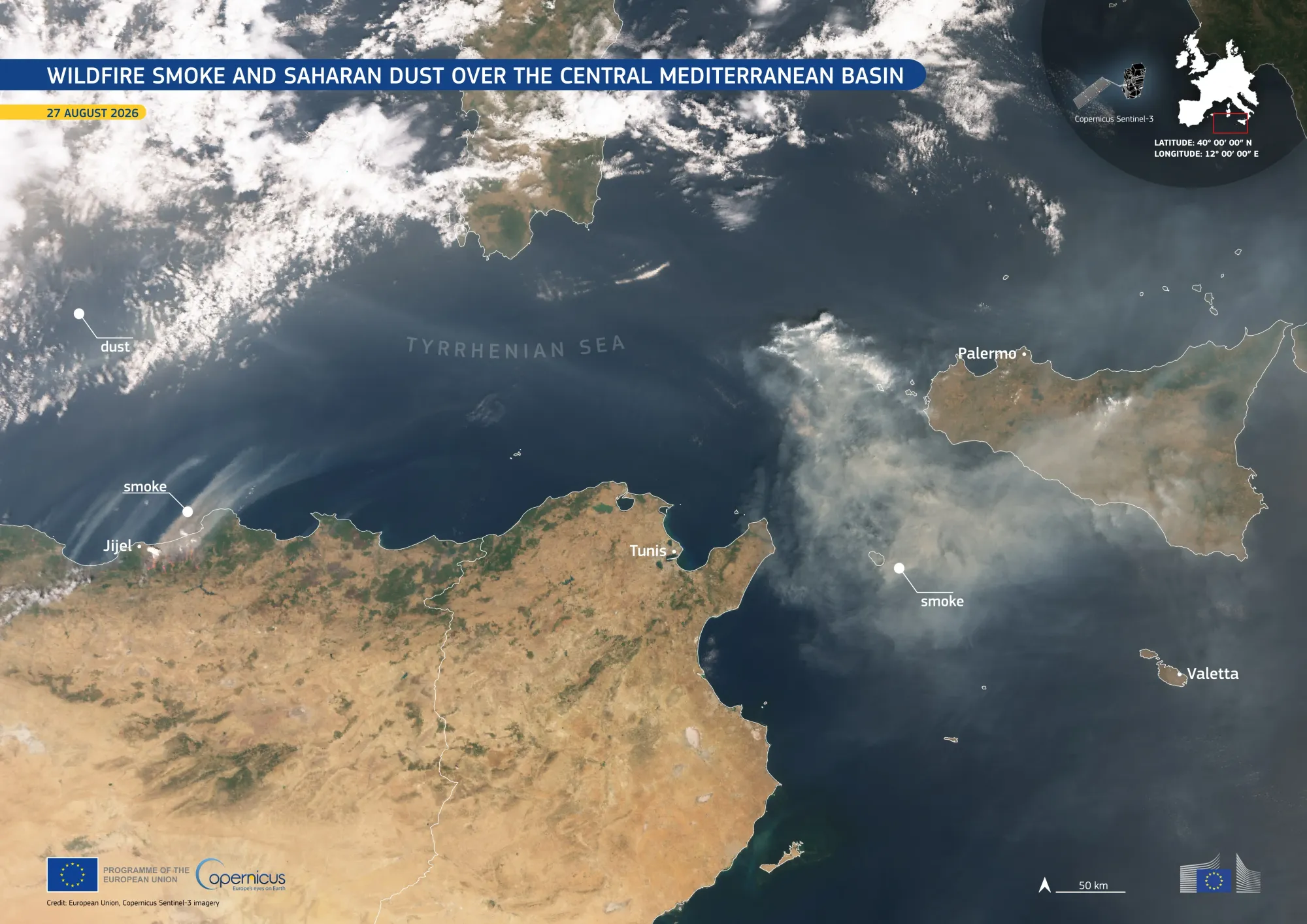
In Algeria, temperatures close to 50° C (122° F) and strong winds fueled hundreds of wildfires in the country’s northeast, killing at least 12 people. Temperatures also neared 50° C (122° F) in Tunisia, where tap water and electricity cuts have contributed to discontent and protests against the authoritarian government of Kais Saied. The situation has also been dire in the camps in central and southern Gaza, where around 1.9 million Palestinians displaced by Israeli bombardment are living in tents that, during the summer months — when temperatures often hover around 35° C (95° F) — can turn into ovens and fill with insects.
Warmer seas, heavier rain. In late August, the global ocean surface temperatures reached a new record, surpassing even the alarming levels recorded in 2024 — which we covered in this issue of Lapilli+.
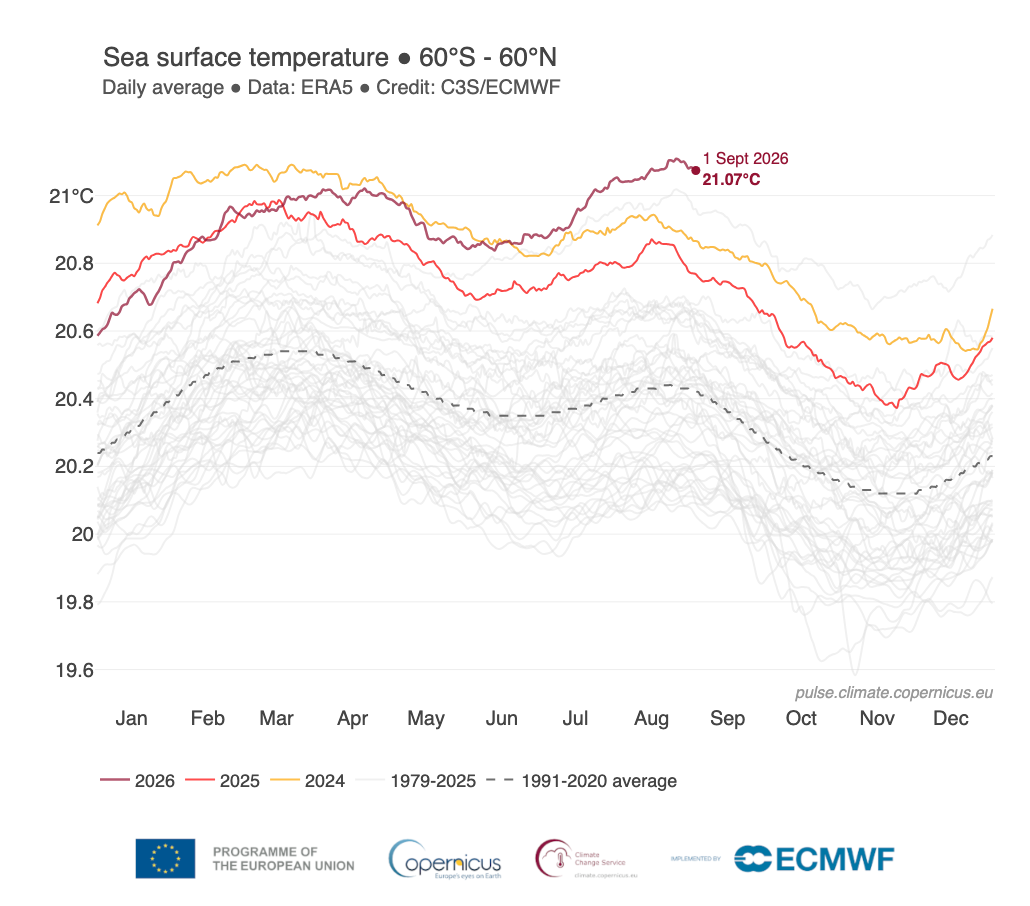
Temperatures far above seasonal norms have also been recorded across the Mediterranean — particularly in the western basin — and other European seas this summer. According to a recent analysis by the attribution-science initiative World Weather Attribution, the sea surface temperature anomalies observed in July would have been virtually impossible without the excess greenhouse gas emissions released into the atmosphere by human activities since the Industrial Revolution.
“This has been a remarkable summer for heat across Europe, but the impacts on our coastal waters are not as well reported,” said Dr. Claire Bergin, a climate scientist at Ireland's Maynooth University and a co-author of the study, as quoted in this LinkedIn post. “Our attribution analysis shows that human-induced climate change has directly added about 2° C (3.6° F) of heat to the Mediterranean to date and over 1.3-1.4° C (2.3-2.5° F) to Western European seas."
Scientists focused their analysis on the warmest 14-day periods within July. According to the study, observed values have increased by 3.1 (5.6° F) and 2.6° C (4.7° F), respectively, in the Western and Eastern Mediterranean, compared with the preindustrial period — well above the current level of global warming of roughly 1.4° C or 2.5° F.
Beyond their ecological impacts, warmer coastal waters can affect public health and tourism and contribute to the formation of extreme weather events — as happened with the DANA event that hit Valencia in 2024.
As the planet continues to warm, researchers say marine heatwaves are likely to become more frequent and intense, making adaptation increasingly difficult. “A rapid transition away from fossil fuels,” the study’s authors conclude, “is essential to save crucial ecosystems, fisheries, food production and tourism along the European coasts.”

The Mediterranean’s next new inhabitants. As we’ve highlighted in previous editions of this newsletter — and in this series from Magma Magazine — warming ocean temperatures are having a profound effect on the biodiversity of our seas. When they can, species that prefer cooler, more temperate climates escape the heat by moving northward, while those that tolerate or prefer warmer waters expand their geographic range. One particularly important pathway for this expansion into the Mediterranean didn’t exist until 1869: the Suez Canal, which connects the mare nostrum with the Red Sea and, from there, the Indo-Pacific.
In a recent study published in the Journal of Animal Ecology, a group of zoologists from Tel Aviv University analyzed data from 247 underwater cameras installed at the northern end of the Red Sea and along the Eastern Mediterranean coast. They wanted to compare the features of species that venture into the Mediterranean with those of species that remain confined to tropical waters.
One distinctive trait they identified was the ability to survive in shallower waters without coral reefs and over sandy seabeds. Considering the characteristics shared by species that have successfully adapted, the researchers concluded that fish such as the cinnabar goatfish (Parupeneus heptacantha), the starry puffer (Arothron stellatus) and the yellowspotted trevally (Turrum fulvoguttatum) could be among the Mediterranean’s next new inhabitants.
“Until now, researchers have tried to understand biological invasions primarily by examining species that had already reached the Mediterranean,” said one of the study authors, Jonathan Belmaker, in a statement. “We took a step back and asked what characterizes these species before they begin their journey” (Nautilus).
Getting ahead of the problem could help prevent biological invasions from reaching the scale of the blue crab invasion in the Central Mediterranean — even though the species most commonly found in Italy did not enter through the Suez Canal.
A recent report, featuring photographs by Chiara Negrello, looks at the transformations this exotic species has triggered in the Po Delta. And if you want to learn more about the latest efforts to contain the problem in a nearby area — Cesenatico, Rimini and Cattolica — we recommend this article from Scientific American about an ongoing project led by researchers at the University of Bologna. The project aims to bolster the local octopus presence by releasing hundreds of thousands of individuals — one of the few natural predators of the blue crab found in the Mediterranean — to curb the invasive species’ population.
This approach does come with some doubts. Octopus paralarvae have an extremely high mortality rate. And even if many manage to survive, they could prey on other crustaceans or become prey themselves. Either way, it’s too early to know how things will play out.

The threat of ships in a whale sanctuary. This year, researchers from the Tethys Research Institute say they have spotted more cetaceans in the Ligurian Sea than in previous years: more than 130 between May and July. Possible reasons include a greater abundance of krill — the tiny shrimp-like creatures eaten by many cetaceans, including fin whales — as well as more days of calm seas.
During their trips this summer, researchers encountered fin whales, sperm whales, Culvier’s beaked whales and several species of dolphins, including Risso’s dolphins, bottlenose dolphins and striped dolphins. But these observations are not definitive data on the populations living in this part of the Mediterranean.
The area monitored by the Tethys team is part of the Pelagos Sanctuary, the largest marine protected area in the Mediterranean, spanning Italy, France and Monaco. The sanctuary covers a triangle of water twice the size of Switzerland. Yet despite being established to protect cetaceans, it is crossed every year by hundreds of thousands of commercial vessels, as well as ferries traveling to Corsica and Sardinia, posing a major threat to these marine mammals. Collisions are the leading cause of non-natural death for fin whales and sperm whales. The U.N. agency responsible for maritime traffic recommends that ships slow down in areas where cetaceans are spotted. But because there is no requirement to do so, almost nobody does (Il Post).
This issue — and the solutions being implemented or studied to reduce collisions, both in the Pelagos Sanctuary and along the main whale routes in the Mediterranean — has been explored by one of our teams of fellows. Their work will be published soon in Mongabay and later on our website.
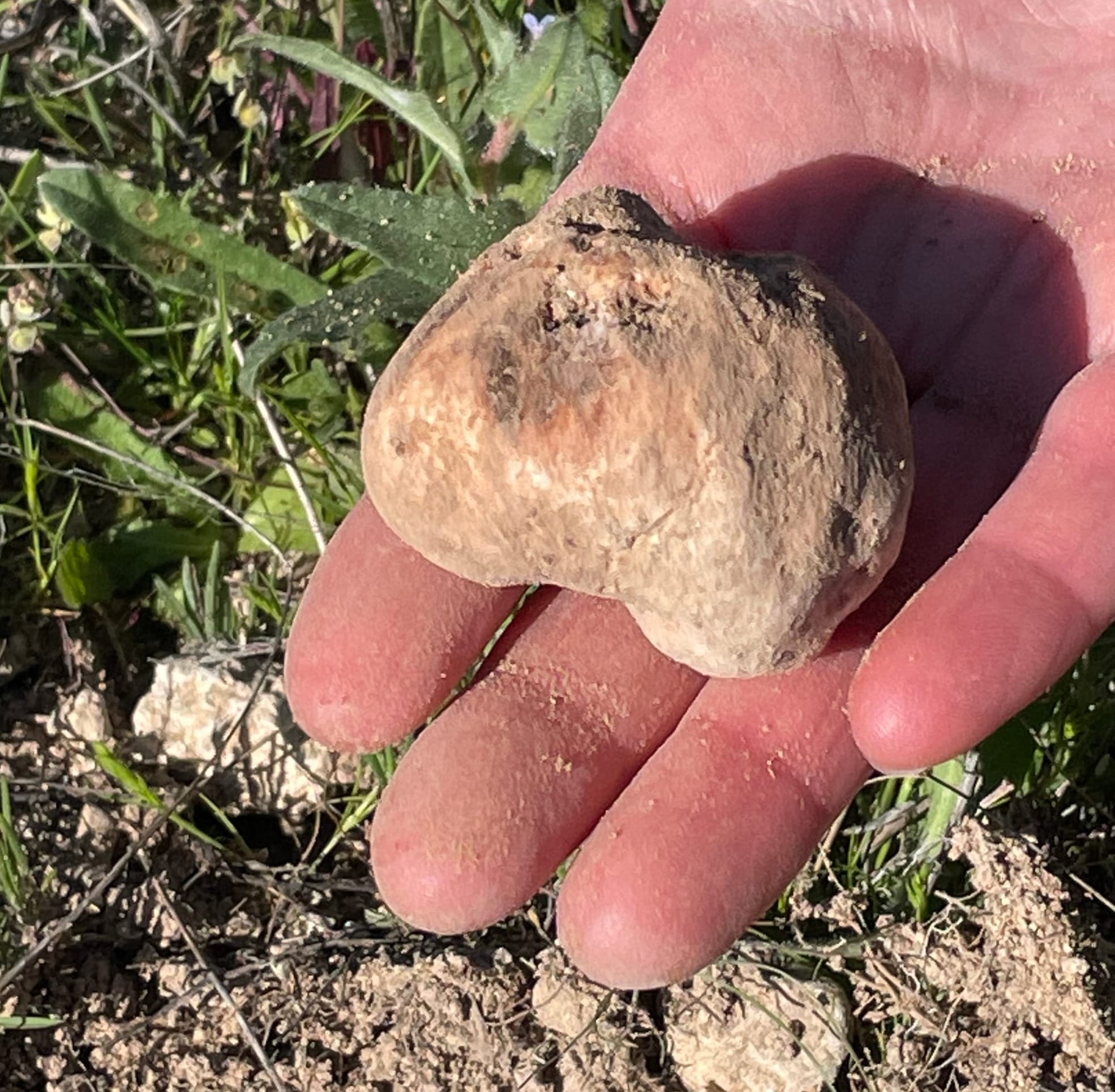
Growing desert truffles in a drying Spain. Another Magma fellow, Ansley Evans, has published her work on the Italian online magazine Lucy sui mondi. During her fellowship, Ansley followed the work of Spanish botanist Asunción Morte, who has long promoted the cultivation of desert truffles in southern Spain. While many crops require large amounts of water, desert truffles thrive in water-stressed soils. And unlike forest truffles, they can be eaten as a food in their own right, rather than simply used to add flavor to other dishes. Highly prized in the Middle East and North Africa, desert truffles grow wild in southern Spain, where they had long been forgotten. Now, some people are rediscovering them. In regions at high risk of desertification, desert truffles could also prove to be a promising crop: They don’t compete for water with other uses and could help improve soil fertility.
Agrivoltaics in Egypt. Sticking with changes in agriculture — and anticipating another topic some of our fellows have been working on — farmers in Egypt are testing solar panels as a way to increase their resilience to water scarcity and rising temperatures. The idea is simple: Covering fields with solar panels allows farmers to generate electricity while providing shade for crops and reducing evaporation. Several funders and partners are supporting two pilot projects to explore whether this technology could help small rural communities across the country and potentially be deployed on a larger scale. For now, though, everything is still at an experimental level — from the arrangement of the panels and the choice of crops to how the electricity will be used. The projects will ultimately take shape based on the results of these trials and the needs of the communities involved (Grist).

Unstable mountains. After the recent flash floods that swept away several villages on the border between Nepal and Tibet, we can’t not talk about the impacts of climate change on mountains. We’re doing so by pointing you toward two recent features, one in the Swiss magazine Das Magazin and the other in The Atlantic.
Starting with the case of Blatten, the Swiss village buried by debris from the Birch Glacier in May 2025, the first article explores the role of permafrost in the instability of mountain landscapes in the Swiss Alps and beyond. About 3 to 4 percent of Switzerland’s surface lies on permafrost — meaning soil, debris or rock that has remained at or below zero degrees Celsius (32° F) for at least two consecutive years. Usually, only the uppermost layer briefly thaws during summer, while everything below remains frozen for centuries or, at high elevations, even millennia.
At least, that used to be the case. Recent measurements show that the frozen ground 10 meters (32.8 feet) below the surface has warmed by an average of 0.8° C (1.44° F) over the past decade. Global warming is also increasing water infiltration into mountains, which can contribute to permafrost thaw and the widening of cracks and fissures. And as ice and snow melt, albedo — the ability of a surface to reflect rather than absorb sunlight — declines, accelerating warming.
Switzerland has already warmed by almost 3° C (5.4° F) since the beginning of industrialization, roughly twice the global average. In the Arctic, the situation is even more extreme, with temperatures rising two to four times faster than the global average.
Permafrost thaw can also bring bacteria, minerals and other substances that have been dormant or trapped for centuries back to the surface. It can reactivate decomposition and anaerobic respiration, releasing additional carbon dioxide and methane into the atmosphere.
As the shorter article in The Atlantic (behind a paywall) highlights, climate change is turning geology into a real-time science. Dramatic events — like the one in Blatten — have pushed scientists to investigate the connections between glacier loss and an increased risk of landslides. Now, ongoing research is even examining how climate change might affect earthquakes and volcanic eruptions.

GUIA BAGGI
As an independent journalist, she writes about the environment, as well as the relationship between humans and their surroundings. In recent years, she has been focusing on the impacts of climate change and other environmental crises on the Mediterranean region. Building on this experience, she co-founded Magma.That's it for this month. Thank you for reading this far. See you in October.
If this newsletter was forwarded to you, you can subscribe here to continue receiving it. Lapilli is free and always will be, but in case you would like to buy us a coffee or make a small donation, you can do so here. Thank you!

