Over the past month, high temperatures, drought and widespread fires have brought the climate crisis back to the center of public debate. From wildfires and heatwaves to their impacts on health and agriculture, this issue of Lapilli examines what’s happening and the challenges we face. We hope this topic will not fade once the summer emergencies are over, but that effective medium- and long-term solutions will continue to be discussed in the months ahead.
And, as always, there's much more. Enjoy!

Hundreds of thousands of hectares in flames. As early as mid-July, impressive images were arriving from France of Canadairs planes drawing water from the Seine to extinguish fires near Fontainebleau, southeast of Paris. In the French Riviera, thousands of people were evacuated at the end of the month. But the largest fires were recorded in the region around Bordeaux, where 42,000 hectares of forest went up in smoke and 22,000 people were evacuated. In Spain, fires hit the area around Madrid, towards Ávila and Toledo. The president of the Madrid region, Isabel Díaz Ayuso, described the situation as "the worst fire in the region's history." In total, more than 110,000 hectares burned in Spain in July, an area slightly smaller than the entire municipality of Rome (BBC, The New York Times).
Large fires have also been recorded in Portugal, Morocco, Tunisia and Algeria. In Greece, the situation was particularly critical in Crete and on the islands of Paros and Andros, where, at the end of July, fires fueled by strong winds forced entire villages to be evacuated. Fires also swept through the western part of Türkiye. In Italy, Sicily has been particularly affected, with hundreds of fires reported.
More than 90 percent of fires are caused, directly or indirectly, by human activity — whether through deliberate acts or negligence. But the succession of heatwaves (we are now experiencing our fourth since early May) combined with severe drought and strong winds has created ideal conditions for the flames to spread.
The European Union publishes updated data every week on the number of fires and the extent of the areas affected. The latest bulletin of August 5th reports that 498,823 hectares have burned since the start of the year, well above the 379,392 hectares that burned during the same period in 2025 (the worst year on record), and far above the long-term average of 197,347 hectares.
The effects of the heatwaves. Heatwaves have been following one another for months (four since May and June was confirmed as the hottest June for western Europe since temperatures were recorded) bringing temperatures above 40 degrees Celsius (104 degrees Fahrenheit) in many Mediterranean areas. In Sardinia temperatures exceeded 40°C (104°F), especially in internal areas. In Uta Santa Lucia, in the metropolitan city of Cagliari, the temperature reached 47.8°C (118°F) at 4.35pm on July 16th, a value just 0.4°C (0.7°F) lower than the record of 48.2°C (118.8°F) recorded in Jerzu and Lotzorai on July 24, 2023.
And with the heat comes drought. Rivers and lakes all over Europe are suffering from water shortages, as can be seen from this European Drought Observatory map. Very high levels of drought, indicated by the color red, are observed in almost all of France and in the Po basin. Scientists from the World Weather Attribution highlight how this year's drought is due less to a lack of rain and more to prolonged heatwaves, which make water evaporate faster than rainfall can replenish it.
“We are seeing water supplies evaporate out of our soils and rivers faster than we would have in a world without climate change, turning what would have been manageable dry spells into severe droughts,” said Sarah Kew, climatologist at the Royal Netherlands Meteorological Institute, as reported in a Linkedin post.
These sustained high temperatures are negatively impacting human health — causing issues like disrupted sleep patterns — while also severely damaging agriculture and aquaculture. June was particularly brutal for wheat farmers, who faced losses estimated near two billion euros ($2.3 billion), as fields across France turned from green to brown, a shift so dramatic it was visible in satellite imagery.
Aquatic life is also in distress due to the extreme heat. Climate change-induced heatwaves have driven water temperatures up at the mouth of the Po River, leading to the death of up to 90 percent of the clams in the Sacca di Goro area, near Ferrara. Furthermore, the combination of intense heat and drought has triggered a massive algal bloom — the worst in 10 to 15 years. This has forced workers to clear the algae manually to protect their harvest and prevent severe oxygen depletion (Ansa).
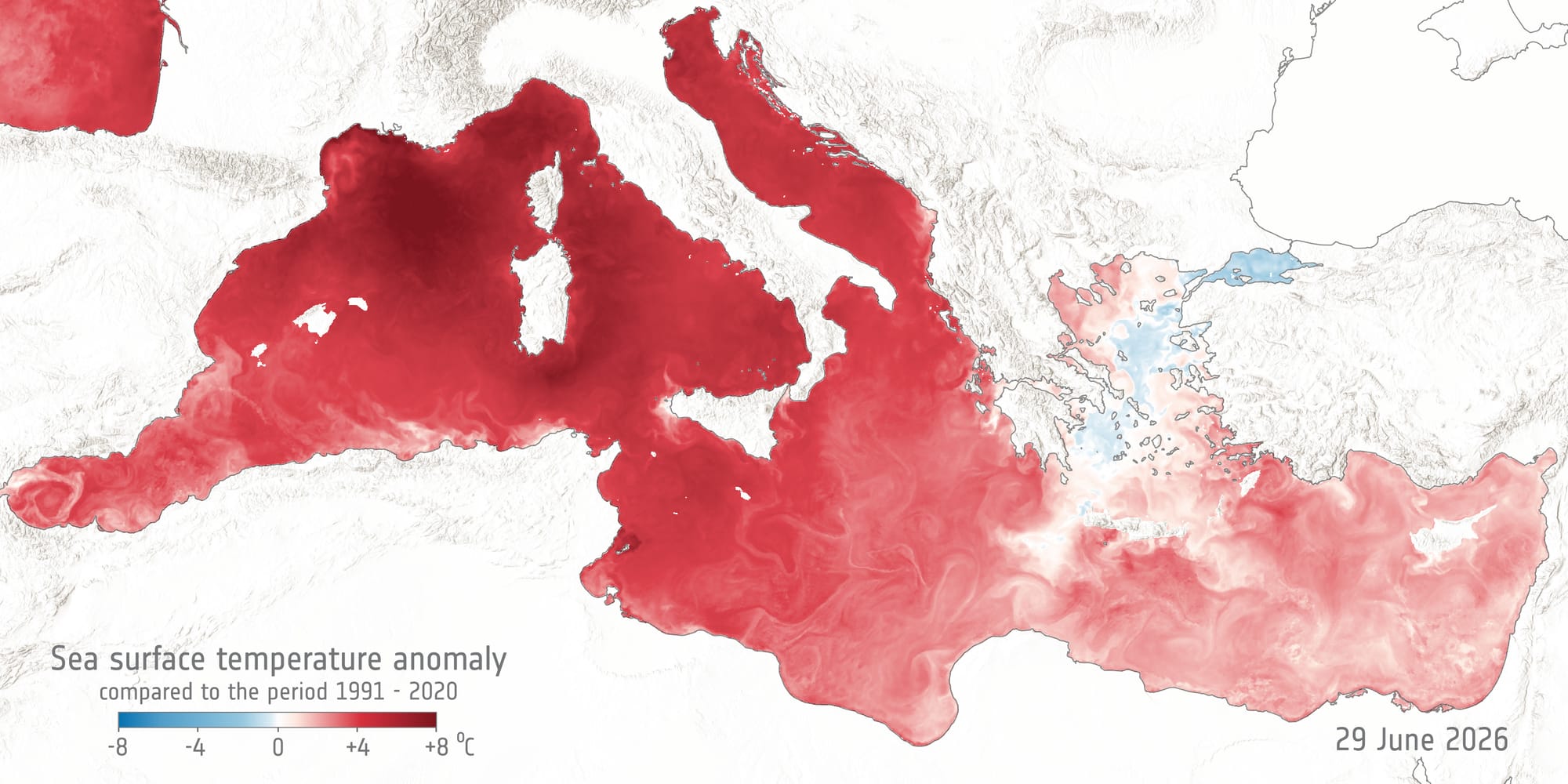
Conditions are equally alarming at sea. On July 1st, the European Space Agency published an image showing temperature anomalies compared to the 1991–2020 average, with dark red areas reaching 8°C (14.4°F) above average. By July 30, surface temperatures in the Mediterranean hit approximately 30°C (86°F), matching tropical conditions. Giulio Betti, a meteorologist and climatologist at the Italian National Research Council, noted in an Instagram post that such figures are statistically unprecedented, especially considering that sea temperatures typically do not peak until August.
Driven by human-induced global warming, heatwaves across the Mediterranean basin are becoming more frequent, lasting longer and reaching unprecedented temperatures. This shift is disrupting long-established atmospheric circulation patterns and fundamentally changing how air masses move and interact.
Historically, the Azores High acted as a buffer, steering cooler Atlantic air over Europe. Today, however, it’s increasingly being replaced by subtropical high-pressure systems extending from North Africa, which draw intense Saharan heat northward. This pattern is reinforced by the rapid warming of the Arctic, which weakens and slows the jet stream. The result is the formation of so-called "Omega blocks" — persistent high-pressure systems that can remain over Europe for days or even weeks, trapping hot air and preventing cooler Atlantic air from moving in.
A surge in solar power. The recent heatwaves have had at least one positive outcome: record-breaking solar power generation. In June 2026, solar became the European Union's largest source of electricity for the first time. Spain played a major role in this milestone, with photovoltaic (PV) power supplying 34 percent of the country's electricity, one of the highest shares in the EU.
The record came at a crucial moment. As soaring temperatures drove up demand for air conditioning and put the power grid under strain, solar generation surged. At the same time, extreme heat and reduced water availability limited the output of some conventional power sources, allowing PV to help meet peak demand.
As a result, solar accounted for 25 percent of the EU's electricity mix in June, ahead of nuclear (21 percent), gas (15 percent), wind (14 percent), hydroelectric power (12 percent) and coal (8 percent) (Euronews).

Fire risks are rising in southern Europe despite improvements in prevention. A study published in late July in the scientific journal Scientific Reports reveals that while the total number of fires has dropped in countries like Portugal, Spain, France, Italy and Greece, weather conditions are making outbreaks increasingly widespread and difficult to control.
The research shows that the number of days with conditions highly favorable to wildfires has increased sharply. In several regions across the countries analyzed, the number of high-risk summer days rose from fewer than 10 per year between 1981 and 2010 to around 25 days annually over the past decade.
At the same time, the annual number of wildfires over the last ten years has fallen by about 40 percent compared with the 1981–2010 average. The decline is largely attributed to a reduction in human-caused ignitions, which are responsible for the vast majority of fires. Improved monitoring systems, stricter regulations and greater public awareness have all contributed to this trend.
The authors also stress the need for better land management and more proactive wildfire prevention. Among the measures they recommend are prescribed burns and the restoration of wetlands and other water bodies, which, when adequately replenished, can act as natural firebreaks and help slow or stop the spread of wildfires (Euronews).

Even Parmigiano Reggiano suffers from extreme heat. High temperatures have negative effects on production of this renowned type of cheese: Heat stress causes cows to eat less and spend more time lying down, reducing milk yields by up to 10 percent while also affecting milk quality. In addition, drought limits the growth of grass and forage — the only feed allowed under Parmigiano Reggiano production regulations — further threatening cheese production.
According to producers, if heatwaves become more frequent and prolonged, the combined effects of lower milk yields, reduced fodder availability and higher production and storage costs could jeopardize both the quality and profitability of one of Italy’s most valuable agri-food products, a sector worth 4.5 billion euros a year (about $5.2 billion) (Reuters).
The fragile landscape of 'The Odyssey'. In a previous issue of Magma Magazine, we explored the environmental impacts of tourism in depth (you can read the related features here). In this newsletter, we turn our attention to Messenia, in the Peloponnese, where Christopher Nolan's film “The Odyssey” was recently filmed. The region is now preparing for a potential surge in tourism fueled by its appearance on the big screen.
Yet Messenia is already under considerable environmental pressure. Over the past three decades, average temperatures have risen by 1.5°C (2.7°F). Increasingly hot summers and drier winters have reduced the natural replenishment of groundwater reserves. At the same time, the expansion of luxury tourism has intensified demand for water. High-end resorts with private pools and sprawling golf courses consume vast amounts of a resource that is already scarce. According to several experts, these developments place an unsustainable burden on local water supplies, despite being marketed as environmentally friendly.
Many residents and researchers fear that Messenia could follow the path of Dubrovnik, where the success of “Game of Thrones” helped transform the city into a symbol of overtourism. At the same time, alternative models are emerging across the region. Slow tourism initiatives are helping revive abandoned villages, support traditional crafts and celebrate local identity while preserving the landscapes that make Messenia unique (The Guardian).
A similar risk also concerns Favignana, the Sicilian island that hosted some of the film's shooting. The arrival of millions of euros in investments and a possible tourist boom could severely test the island's delicate environmental balance (Artribune).



GUGLIELMO MATTIOLI
As a multimedia producer, he has contributed to innovative projects using virtual reality, photogrammetry and live video for The New York Times. In a past life, he was an architect and an urban planner, and many of the stories he produces today are about the built environment. He has worked with publications such as The New York Times, The Guardian and National Geographic. Born and raised in Genoa, Italy, he has been living and working in New York City for more than 10 years.That's it for this month. Thank you for reading this far. See you in September.
If this newsletter was forwarded to you, you can subscribe here to continue receiving it. Lapilli is free and always will be, but in case you would like to buy us a coffee or make a small donation, you can do so here. Thank you!

